By Greta Petry
Tears, prayer, song, and hope marked a memorial service held at the Recreation and Convocation Center on September 21.
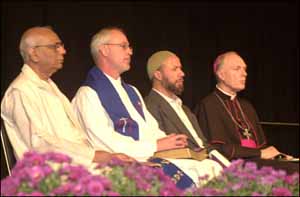
Representatives of the Jewish, Catholic, Muslim, Protestant, and Hindu faiths gave readings and prayers, as the University community met to honor the victims of the September 11 terrorist attacks. Imam Djafar Sebkhaoui of Masjid al-Hidaya mosque, said that friends from many religions in the Capital Region have reached out to the Muslim community, and do not associate those who are Muslim with those who are guilty. He said that more than 1,000 Muslims are missing and presumed dead in the tragedies.
In a darkened RACC, the ROTC Color Guard carried the American flag and led the procession to the stage. Some fought back tears as the Albany Police Pipe Band played "Amazing Grace" on bagpipes. A member of Albany Pro Musica wiped tears away after singing a powerful rendition of "America the Beautiful." 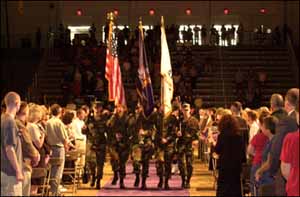
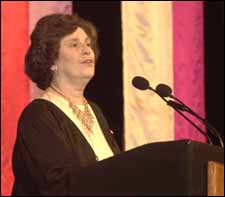
University President Karen R. Hitchcock said, "The cruel tragedy we all share, though now some ten days in our collective past, remains as vivid and horrifying as it was during the morning hours of September 11. It will remain in our minds and hearts for the rest of our lives . . . seared into our consciousness by the enormity of human anguish." The citizens of more than 80 countries were lost on September 11.
"And even as our brothers and sisters across the globe suffer their own painful losses, they have reached out to us here at the University at Albany," the president said. "We have heard from the Chancellor of Moscow State University and the Rector of the Universidad Del Salvador in Buenos Aires, from colleagues in Israel, India, China, England, Saudi Arabia, France, and on and on. Their message? 'We are grieving and mourning with you.'"
Hitchcock said the tragedy has hit home at the University at Albany as well. "Our students, faculty, staff, and alumni have lost mothers, fathers, brothers and sisters, aunts, uncles, cousins and beloved friends . . . We have lost women and men who graduated from our University, and who greatly enriched their alma mater by their presence. Some were firefighters, others I am certain displayed acts of quiet courage we will never know. All were innocent people whose loss affects us deeply."
The president said the University is united in its compassion and prayers for those who lost loved ones, and in its commitment to the democratic ideals of freedom and the value of human life.
"As painful as it is to do so, we must commit to memory these tragic events in honor of those who have suffered . . . those who have been lost. And commit ourselves to our belief in the rights of people everywhere to life and to freedom . . . to our abhorrence of hatred, violence, bigotry, and the ignorance that breeds these evils."
Hitchcock said the University community is united by common values that include the belief that knowledge can triumph over cruelty and violence; the affirmation of the sanctity of each human life; and the belief that differences can be bridged with compassion and mutual understanding. "Now, more than ever before, we must, together, speak out and must stand up for these beliefs," she said.
The president said the past several days have been marked by selfless "acts of courage and compassion" in the University community. Students, faculty, staff, alumni and community neighbors have donated blood, medical supplies and money for the victims, joined the rescue efforts in New York City, and provided trauma and grief counseling. "I am so very proud to be a part of such a loving community," she said.
The president added, "We can, together, persevere through this terrible time. Love will triumph over hatred and ignorance. We know this in our hearts. Yes, this is the memorial we can build together to honor those we have lost . . . those who will always be in our hearts and in our prayers."
Bishop Howard Hubbard of the Albany diocese had just come from the funeral of John A. Reo, 28, an Albany alumnus who worked for the Cantor Fitzgerald brokerage firm. Reo and his brother-in-law lost their lives in the World Trade Center collapse. In addition to Reo and other alumni, Hubbard said the father of one UAlbany student died; three more fathers are missing; two uncles; one aunt; the relative of a staff member died at the Pentagon; and another staff member's firefighter brother is missing. 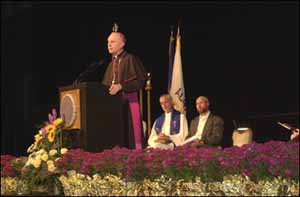
And yet, in the midst of all this suffering, Hubbard said it must be remembered that "ours is not an age of terror but of liberty that seeks justice, not vengeance." Noting there have been hundreds of incidents of violence, ethnic slurs, and threats against Muslims in the U.S., he prayed for the safety of "our Arab-American and Muslim brothers and sisters."
As horrifying as the events of recent days have been, Hubbard said they nevertheless bring into focus what is really important, including trust in God's providence, the sanctity of human life, and the dignity of every human being. Out of the attacks have come the heroic actions of the firefighters, acts of kindness shown to strangers, and an outpouring of love, support, generosity and prayers.
"God never abandons us," he said, adding that faith offers hope, healing and consolation in an age of "shallow and superficial concerns."
Hubbard said trusting in God's providence is needed as we realize stopping terrorism is not a "romp or few days of intensive work," but will take months and years.
And a historical perspective is needed to remind us that others have successfully faced grave challenges before.
Saying that we need to "trust God in adversity," Hubbard used the example of the actor Michael J. Fox, who suffers from Parkinson's disease and who recently told an interviewer, "I've never been happier in my life."
Prior to his disease, Fox's biggest problem was finding a parking spot for his Porsche. But now he is focused on helping others who have the debilitating disease.
"God did not cause the disease, but God empowers the walk," Hubbard said. He also quoted Judy Shepard, the mother of slain gay college student Matthew Shepard, who told a UAlbany audience last year that hatred is a learned behavior, and the only hope for the world is to unlearn this behavior.
Hubbard said we can't let terrorism take away our humor, which lends a sense of proportion to incongruity. Retaining an ability to laugh at ourselves helps us avoid anxiety.
Finally, he said that hope continues. While there is no question we are facing a crisis, the dictionary defines crisis as "a turning point." While some are discouraged, the crisis of September 11 gives us an opportunity to do better, to live in greater understanding among diverse cultures so that "we can truly renew the face of the earth. My hope is that we fulfill this challenge to honor the glory of God," Hubbard concluded.