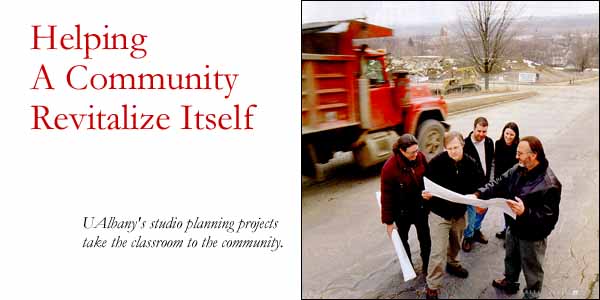
Imagine having a say in the design of your city or neighborhood. Your input would help determine how streets are laid out, green space is used, new construction is integrated into the existing architectural style, and even which measures would promote safety and discourage crime.In essence, that is what the University at Albany's Urban and Regional Planning Program does through its studio planning projects. Since arriving at UAlbany in 1994, Assistant Professor Cliff Ellis has supervised studios for such clients as the Town of Stuyvesant, Battenkill Conservancy, Champlain Canal Trail and Schoharie Revitalization Committee. Ellis, who integrates teaching and research with practice, worked last year with students on a project titled "Revitalization Strategies for North Albany." Focused on an area bounded roughly by Broadway, the Albany-Menands border, and Van Rensselaer Boulevard-Loudonville Road, the project addressed four issues: safe streets, community "gateways" and Connections," housing, and community facilities. The students presented their findings to neighbor hood residents last December.
Kate Frank got the ball rolling for the project. Convinced that the planning studio would "provide a good opportunity for the students and resi dents to pursue and implement community improvement," she approach ed Ray Bromley, chair of the Depart ment of Geography and Planning, to request assistance. Frank, who took two planning courses at UAlbany in the late 1980s, also secured $5,000 in Albany Community Development Agency funding to support the studio.
"It was a win-win situation," says Frank, who also works for the North Albany HOPE VI office, which is part of a federally funded effort to revitalize public housing, improve family self-sufficiency and promote healthy urban neighborhoods. She said the stu dents "put forth very creative, very practical suggestions about lighting, sidewalks, landscaping" and other issues related to safety, aesthetics, transit and community cohesiveness. They also proposed a community center "They did a great job," Frank adds.
As a member of the Safe Streets croup, Jaclyn Hakes, a HOPE VI intern at the time, helped to address concerns related to pedistrian and traffic safety. Now in her final semester in the Master of Regional Planning Program, she did a survey to evaluate each building or lot, looked at everything from sidewalks and curbs to street trees, and interviewed neighborhood residents to gather their input. She also coordinated a presentation that incorporated the students' suggestions for revitalizing North Albany.
Mimi Rayl of Saratoga Springs was impressed by the professionalism of her fellow students and by the commitment of members of the community. "They were so helpful and open to participating in the process," notes Rayl, who changed her career direction in 1998 when she left her longtime position as project manager for a home building company in California. An interest in helping older industrial communities revitalize themselves led her to pick up the phone and speak with UAlbany's Bromley. "He suggest ed I might want to give the program a try," she recounts. "I'm finishing up this year."
Rayl's North Albany team explored how to establish gateways and connections that "might reinforce the neighborhood's sense of identity." The students suggested, for instance, that special crosswalks, pedestrian islands, street trees and a narrowing of the roadway to slow traffic could mark a transition from busy roadway to residential area. They also discussed with the Capital District Transportation Authority and other public agencies new ways to connect the neighborhood with surrounding communities and to expand access to services for North Albany residents who do not drive.
For Sean Maguire, the North Albany planning studio was something of a homecoming. "I was born there and baptized at Sacred Heart Church, which is at the center of that community," explains Maguire, who now resides in Albany's Delaware Avenue neighborhood.
A Capital District Regional Planning Commission intern, Maguire received both a B.A. in geography and urban planning and a Geographic Information System (GIS) certificate from UAlbany last May. For the planning studio, he said, "I provided a history of the neighborhood, GIS information and maps. The history was by far the most interesting aspect of the project,for me. Aside from the usual research, I talked with people in the community about their memories of the neighborhood; they were a tremendous source of information. Also, I had the opportunity to see some great old images of North Albany and connect with a neighborhood that was home to generations of my famiily."
Now in the process of finalilzing the plan in written form, the students know that it may be some time before their recommendations are implemented. Hakes looks forward to visiting North Albany one day to see the enhancements in place: "That would be the greatest reward," she says.