A sampling of names and stories from the University at Albany�s Veterans Wall of Honor:

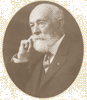
Albert N. Husted
He became a math instructor at what was then the New York State Normal School and, in 1862, along with math professor Rodney Kimball, organized more than 200 faculty, students and alumni who fought in 17 Civil War battles as the 44th New York Volunteers, the so-called "Normal Company."
Capt. Kirtland W. Perry (1881) Perry�s ship, Manning, was stationed in Alaskan waters in 1912 when volcanic Mount Katmai erupted nearby. President William Taft cited Perry and his crew for their heroics for remaining in port and risking their lives to assist trapped Alaskans instead of putting out to sea.
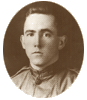
Edward Potter (1918)
After enlisting a month after the start of World War I, Potter, a lieutenant in the Army Flying Corps, was preparing to land at Orly Field near Paris and noticed at the final instant a number of people on the airfield. He veered of sharply to avoid casualties, crashed and died in an ambulance on the way to a Paris hospital. He is buried in Suresnes, near Paris.
Fred Hardemeyer (1936) He left his job as an Albany High School instructor to enlist in the Canadian Army during World War II and became a member of its famed infantry unit, Black Watch Regiment � nicknamed "the Ladies from Hell" because of their kilts. He was captured by German soldiers in 1942 during a raid on Dieppe and spent three years as a prisoner of war in Germany. After his release and discharge from the Canadian Army, he enlisted in the U.S. Army the following day, just after the Japanese attack on Pearl Harbor. He died in 1988.
Howard Anderson (1942) Caught behind enemy lines and surrounded by German soldiers for three days in Tunisia during World War II, Anderson and two other American soldiers tramped 100 miles through German-held territory. Assisted by two Arabs who hid and fed them, they traversed difficult mountain terrain to rejoin the U.S. Army.
Lt. Col. Sally Beard (1942) She served as an Air Force nurse from 1951 to 1978 and tended to wounded soldiers in the Korean and the Vietnam wars. She later conducted research on decompression sickness, was assigned to the Pentagon and retired in 1978. She lives in New York City.
Capt. Jordine Skoff Von Wantoch (1953) A protégé of the late UAlbany faculty member and philanthropist M.E. Grenander, who encouraged her to enter military service. Von Wantoch served in the Navy and, after her daughter was born in 1970, was instrumental in changing rules for women in the military that at the time required a resignation upon becoming pregnant. She was among the first women to attain the rank of Navy captain and to be assigned a command. She retired in 1986 after 30 years in the Navy.
Maj. April Richardson Moore (1999) A flight nurse in the New York Air National Guard�s 139th aeromedical evacuation flight, she was stationed in Saudia Arabia in 1990 and England in 1991 during Operation Desert Storm.
|
 |

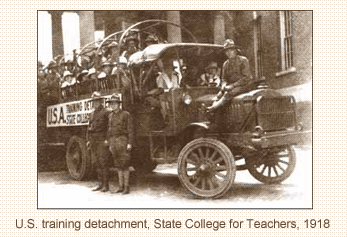
By Paul Grondahl A small corps of dedicated volunteers brought UAlbany's sweeping new Veterans Wall of Honor into being. The University at Albany will unveil a Veterans Wall of Honor on June 9 th, one of the most ambitious and comprehensive efforts ever to commemorate military service on a college campus. The extensive research behind the large-scale installation began with the resolve of a single alumna, who spearheaded the project because she didn't want the sacrifice of UAlbany students who served in the Civil War to be overlooked. "I said I had to correct that omission. This all grew out of my chance reading of a small item on the Civil War in a university publication," says alumna Eunice Whittlesey of Glenville, Class of '44. After 18 months of dogged research by Whittlesey and her small band of volunteers, UAlbany veterans of numerous wars and peacetime active duty will travel to the uptown campus on June 9. The unveiling of the Wall of Honor and a daylong veterans tribute on that day are part of the school's reunion weekend. "The university wanted to create a lasting tribute where the faces and names of our veterans live as a constant reminder to future generations of the cost of living in a democracy," says Melissa Samuels, director of alumni relations, who helped organize the project. The Veterans Wall of Honor will be installed in the main library on the academic podium. It is a 36-foot-long, multimedia mural that incorporates painted portraits, photographs and the names of nearly 3,000 students, faculty, staff and alumni who served in the military. The roll call of names begins with Charles Kendall, an 1846 graduate, who died of disease in Jalapa, Mexico, after fighting for his country in the Mexican-American War.
Honor all vets
Geoff Williams, the UAlbany archivist who assisted the volunteers, views the Veterans Wall of Honor also as a kind of mirror reflecting the university community's response to various conflicts. "There is a sharp contrast between the heroes' welcome veterans returning from World War II received and Korean War veterans, who got very little attention and were basically forgotten when they came back," Williams says. During World War II, UAlbany students mobilized to support the troops by selling war bonds, knitting socks, organizing letter-writing clubs and sending packages to the front. "Then you get to Vietnam, which was a very divisive war on this campus, and our students led protests and rioted against U.S. involvement," Williams says. Campus sentiment was so strongly against students who served in Vietnam that one veteran wrote university officials that he felt uncomfortable returning to his UAlbany reunion and stayed away, Williams says. Whittlesey sees the project as an opportunity to begin to heal just such wounds of war. "This is a testament that students are honorable and courageous and will answer their country's call when necessary," says Whittlesey, a past president of the UAlbany Alumni Association and a commission member on the Statue of Liberty and Ellis Island restoration projects. Whittlesey put in months of research and oversaw the project in honor of her fallen classmates. "My class was just decimated by World War II," she says. About 100 men from her class were away in military service, leaving only five men among roughly 150 women who participated in graduation ceremonies the spring of 1944. Whittlesey's core of helpers included Helen Brucker Martin (class of '44) of Rotterdam Junction; Eleanor Alland ('48) of Guilderland; Virginia Carney ('42) of Buffalo; and Whittlesey's husband, Joseph, a Cornell University graduate. With Samuels' help, they met several days each week at the UAlbany archives and solicited information from alumni by phone, mail and via the Internet.
Thousands respond
"I like a challenge, I enjoy organization and I love working with people who are excited about an idea," says Whittlesey, who worked on gubernatorial campaigns for Nelson Rockefeller and was a high-ranking official for the Republican state and national committees. "It was an enormous undertaking that started from scratch," Williams says. Since there was no central repository or database on UAlbany veterans, the volunteer researchers began poring over class yearbooks starting in 1900, hunting for references to military service. They did the same with various incarnations of student newspapers, beginning with a monthly, The Echo, first published in 1892. With those leads, they attempted to round out the portraits by a solicitation for more information from classmates, friends and family members. A call for help went out to UAlbany's network of 124,000 alumni and the response was extraordinary. "The photos and letters poured in," Samuels says. The replies ranged from a few sentences to dozens of pages offering dramatic combat recollections. In fact, the list of 3,000 names is certain to grow, Samuels says, and the mural has been designed so that it can be expanded. The veterans' database is being organized and cataloged for eventual inclusion in a UAlbany veterans Web site, according to Williams.
Wall of Honor
"I hope it has the intimacy of looking through a family photo album," says Albany artist Dahl Taylor. It is the largest project yet for Taylor, a commercial illustrator and portrait artist, who spent the past year culling hundreds of snapshots and selecting two dozen men and women in various eras and branches of the military. They are the subjects of oil paintings on nine 6-foot by 4-foot fiberboard panels. Arranged chronologically, beginning with the mid-19th century, the painted portraits in a light oil wash of earth tones merge with 80 black-and-white and color photographs attached to the panels. Above them, clear Plexiglass panels with lists of names seem to float like a receding memory. "I looked at these faces for so long and there's an overwhelming feeling of dignity and of ordinary people doing extraordinary things when asked to serve," Taylor says.
Personal chords
It spurred Samuels, for instance, to discuss for the first time the Army experience of her father, Louis Urbano, who earned a master's degree from UAlbany in 1951 and is listed on the Wall of Honor. "I grew up knowing my dad did something with tanks, but we never really talked about it," Samuels says. Samuels learned her dad served in Germany with occupational forces from 1951 to 1953 and loaded shells for a U.S. tank unit under cold, wet and miserable conditions on maneuvers in isolated rural areas under the ever-present danger of a possible sneak attack. "We heard from many alumni and relatives of deceased veterans who thanked the university for taking on this project," Samuels says. The Wall of Honor, which cost $37,000, was paid for by gifts from UAlbany friends and alumni, including Whittlesey. "I wanted to honor my classmates with my donation," says Whittlesey, whose back surgeries for a spinal cyst during her college years derailed her hopes for World War II military service. "So many gave so much for our country, including their lives," she says. "This commemoration was long overdue." Link to the UAlbany Veterans Project
|