By Mary Fiess

One short answer: you need to start with scientific savvy across a wide range of disciplines and the kind of state-of-the-art facilities and technological know-how found at the University�s Institute for Materials. With a new $900,000 grant through the �XYZ on a Chip� program of the National Science Foundation, the Institute is collaborating with two other universities to develop a dramatically new kind of tool — in effect, a laboratory on a microchip — for measuring how cells respond to toxins, drugs and other stimuli.
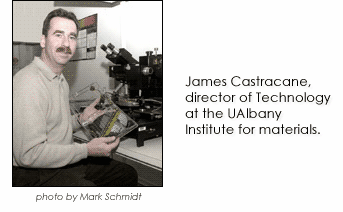
The project reflects the Institute�s growing strength in the hot new field of BioMEMS, says Institute Director of Technology James Castracane. MEMS (micro-electro-mechanical systems) technology is the marriage between traditional microelectronics and mechanical systems to realize a physical device such as the sensor used in air bag deployment; BioMEMS technology applies microdevices to biological and medical problems.
The very nature of the BioMEMS field requires broad scientific expertise, and the three-year NSF project brings together faculty from six academic departments — physiology, veterinary biomedical sciences, mechanical engineering, electrical engineering, physics and chemistry — at three universities, UAlbany, University of Missouri-Columbia (UMC), and University of Louisville (UL). The group also has a business partner to help speed the transfer of the technology to the marketplace.
The challenge for the researchers is to develop a micro-based device to replace or complement two extremely sensitive and powerful electrical techniques now used to study the secretions of cells to determine how they respond to stimuli.
Kevin Gillis, (electrical engineering and physiology, UMC), the project�s prinicipal investigator, uses the two techniques, the patch-clamp technique and carbon-fiber amperometry, to measure secretions from single cells. The patch-clamp technique, which allows the direct recording of the current that passes through a cell membrane, was a revolutionary advance in cell physiology research and its inventors were awarded the Nobel Prize in medicine in 1991.
But both techniques, while providing valuable new information about the mechanisms by which neurons and endocrine cells secrete neurotransmitters and hormones, have limitations. Patch-clamp experiments, for example, must be performed one cell at a time by a skilled (usually Ph.D.-level) experimentalist and thus the execution of those experiments constitutes a bottleneck that limits the pace of scientific progress.
The microchip approach, however, could overcome that limitation.
�With our Institute�s fabrication capabilities, we can make big arrays — hundred of thousands — of micro- or nano-wells into which we put single cells and then do the measurements,� says Castracane.
To fabricate such a device, Institute staff, including senior MEMS scientist Bai Xu, and MEMS postdoctoral student Yahong Yao, will use their well-known expertise in high-resolution lithography and deposition and etching techniques, and the state-of-the-art tools available at the pilot prototyping facility for the current industry standard in computer chip design — the 200mm, or 8-inch, wafer.
Two general approaches will be tested, says Castracane. With the first approach, the microdevices will be fabricated by micromachining various materials such as silicon, silicon oxides (glass, quartz) and silicon nitride. The second approach will be to fabricate devices by replica-molding organic polymers from masters created using photolithography.
While the favored material for traditional MEMS platforms is silicon, it is expensive to micromachine and is not necessarily biocompatible. For those reasons, scientists are exploring alternative materials.
Castracane and Zaichun Feng (mechanical and aerospace engineering, UMC) are responsible for the device layout. Richard Baldwin, (chemistry, UL) is in charge of the electrochemical electrodes that will be constructed on the chips. Feng will model microfluidic flow on the chip, including the use of hydrodynamic forces to position cells without damaging cell membranes. Gillis is designing the electronics necessary for interfacing prototype microchips with external devices. And Gillis and Meredith Hay (veterinary biomedical sciences, UMC) will test the microchips using several different cell types.
ALA, Ltd. of Westbury, NY, the group�s business partner, will offer guidance on the economics associated with different types of microdevices to help assure commercial viability and will market devices that result from the project.
�When fully developed, our microchip-based approach will dramatically increase the rate at which �patch-clamp� experiments can be performed because the fabrication of the recording electrode and its position relative to the cell will be highly automated and massively parallel. It is likely that the entire experiment could occur under computer control with human supervision.
�Experiments that would be unthinkable in the past, such as massive screening of thousands of possible drugs that target ion channels, will be enabled. The analogy of the increase in efficiency that occurred when hand-assembled electronic circuit were replaced by silicon integrated circuit is appropriate,� says Castracane.
Beyond that, all the cross-disciplinary work done to develop this laboratory on a chip will advance the technology for such other possible BioMEMS devices as cell-based biosensors that can warn against contamination of water and food supplies by toxins, says Castracane.