One thing you can rely upon when it comes to computer chips: they will keep getting smaller, faster, more functional, and especially more reliable.
Who makes them so is the multi-billion dollar question. According to the 2001 R&D 100 Awards, sponsored for the 39th year by R&D Magazine, among the top candidates to lead the way is UAlbany�s Institute for Materials in partnership with Gelest Inc. The reason? A new advanced interconnect process that aims to control the motion of minute quantities of metallic impurity atoms that could ruin the smaller chip structures to come.
The R&D 100 awards are among the most coveted for applied research and innovation. Described as the �Oscars of Invention,� they recognize 100 of each year�s most technologically important new products. More than 70 outside judges weigh the merits of hundreds of nominations over the course of three months.
�We�re looking for products and processes that can change people�s lives for the better, and improve the standard of living for large numbers of people,� states an R&D 100 award guide.
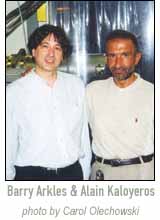
For inventors, the designation means more than simple honor. �It does perform an important role in that there are competing technologies out there, and to get an R&D 100 sets you apart,� said Barry Arkles, president of Gelest, Inc., which is based in Tullytown, PA.
�This is a review by an independent panel of experts. From a dozen makers of technologies trying to find the most efficient path to greater processor speed and efficiency, the R&D 100 award has now essentially narrowed the field down to about three.�
Arkles, a chemist, and Institute for Materials Executive Director Alain Kaloyeros, a physicist, have worked together for nearly a decade, receiving three patents for their research into computer chip technology. �I take what the physicist sees as a problem and attempt to devise a chemical solution,� is how Arkles states his coordination with Kaloyeros.
�Physicists understand the application requirements better than I do — what is going to be the standard required to turn invention into practice. I understand the chemistry required to meet that standard.�
The chemistry in this case involved the two inventors developing gigascale interconnects using titanium and tantalum-based films to accommodate chips at the nano level. By protecting and insulating the wires that connect transistors, the life and durability of chips will be ensured while processing billions of more bits of information than is currently handled.
Even beyond semiconductor applications, the process could have wide economic impact, according to Kaloyeros. He pointed out that titanium and tantalum films form hard protective coatings that can offer greater protection for aircraft components, automotive parts and engines, cutting tools, and even jewelry, as well as prove useful for flat-panel displays and solar cell devices.
The process development took place at Albany NanoTech, the university/industry/government R&D complex run by the Institute for Materials. Designated a New York State Center of Excellence by Gov. George Pataki, it is part of what Kaloyeros describes as the state�s �billion dollar high-tech initiative for funding advanced university R&D, prototyping, workforce training, and economic outreach.�
Its result, in the case of the award-winning Albany NanoTech/Gelest effort, is what Kaloyeros called �a virtual integrated partnership that covers the entire spectrum of skills and resources necessary for semiconductor technology development.�
Arkles pointed out another asset that boosts any effort involving microchip applications and UAlbany: reputation. �The semiconductor industry is going to have to meet new targets for speed and efficiency by 2003 or 2004, and there is a tremendous amount of capital investment that it will have to make to meet that standard,� said Arkles. �For that reason, it will require a level of validation and recognition it can rely upon.
�That is the beauty of what Alain Kaloyeros and the University at Albany have created here. I�ve been in the microelectronic materials side of things for 20 years, and what has occurred at UAlbany is unprecedented — it is an extremely credible site both for new development and for data-citing. Data that comes out of UAlbany is at a level that is respected and relevant beyond any other site in the U.S.
�It is a significant advance from the scientist sitting in the lab, saying, �Eureka, I found it!� It is data readily transferable into commercial situations for industry. So much of that achievement is due to Alain himself. He�s constantly challenging people to achieve and to reach their goals quickly.