Reprinted with permission of the Times Union, Albany, N.Y.
By Roma Khanna
Staff Writer, Times Union
Biodiversity Students Locate a Jewel of a Wetland
Visit the Biodiversity ProgramPreserved wetlands a boon for research
Some call them wetlands; others call them swamps. But for scientists, who understand these marshy regions as first to reflect stress in the environment, they are known as the barometers of the natural world.
As a result, few wetlands in the region have survived without some significant change brought on by humans. But scientists at the University at Albany say they have found one of the purest, best preserved wetlands around — among 70 acres of municipal land behind the Knox Town Hall.
"You can hardly find a wetland in urban America that has not been stressed by human activity,'' said Gary Kleppel, a biology professor at UAlbany. "Finding a wetland like this in this area is like finding a jewel because we have a benchmark with which to compare everything else.''
Wetlands play a unique role in their environments. Kleppel refers to them as "factories'' that can process some of the waste and pollutants from the surrounding environment.
"People sometimes have a negative connotation of wetlands — they think of them as swamps or bogs — but they play an important role in preserving environmental quality,'' Kleppel said. "They tell us something is wrong by the presence of invasive species before they get to our rivers and lakes, so we can step in to catch problems and make changes.''
Seven percent of the land in the state is wetland, according to the Department of Environmental Conservation. Legislation at both the state and federal level works to preserve this rare land type.
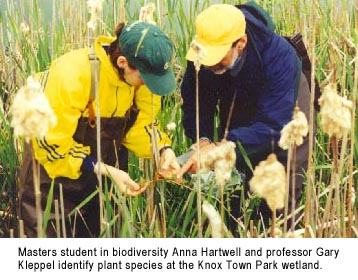
Kleppel and a master's student, Anna Hartwell, have been researching wetlands around Albany County to develop criteria for scientists to evaluate the quality of wetlands.
"We have measurements that we can use as standards to do things like measure the water quality of a river or stream, but we tend not to have too many monitoring tools for wetlands,'' Kleppel said. "We are hoping to create a larger reference system that will assess the state of our wetlands.''
The criteria include measuring the diversity of vegetation, the oxygen level of the water, the number of insect species and the kinds of algae living the water.
On all levels, the Knox wetland has top marks. There are no non-native species living in the habitat, which boasts a thriving population of wetland wildlife that includes green heron and cattails. The quality of the Knox wetland — free from invasive species and other signs of stress — reflects the health of the surrounding environment, which is particularly interesting because it is surrounded by land that has been heavily used for agriculture.
"One might think it would somehow be degraded,'' said Patricia Riexinger, wetlands project manager for the Department of Environmental Conservation.
Riexinger said the standard that Kleppel and Hartwell develop could be useful in measuring the quality of wetlands throughout the state.
"We make a large effort in New York state to preserve wetlands — we buy them, manage them and restore them,'' she said. "But we don't have any objective tools for measuring what quality they are.''