
|
|
|
Continues through Nov. 5, 2000
Opening Reception:
Artist / Curator / Lenders |
ALBANY, NY—The University Art Museum, University at Albany, State University of New York is pleased to announce its fall exhibition:
Searching the Criminal Body: Art / Science / Prejudice
which opens on September 23 and runs through November 5, 2000. Using both historical artifacts and the work of ten contemporary artists, Searching the Criminal Body, explores how our current ideas about criminal behavior are influenced by 200 years of visual information on the subject. The curators, Susan Erony, an artist and independent curator, and Dr. Nicole Hahn Rafter, a professor in the Northeastem University College of Criminal Justice share a mutual interest in history, gender, and the social construction of crime and criminals. Their curatorial selections for Searching the Criminal Bodyshed light on discarded scientific theories about criminal behavior and reflect Erony and Rafter's concern that the latest theories on criminal behavior are met with cautionary vigilance, rather than blind acceptance.
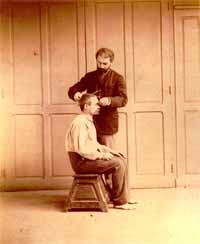 |
Bertillion Measuring a Head, 1883 Photograph 8" x 10" Original in The Burns Archive |
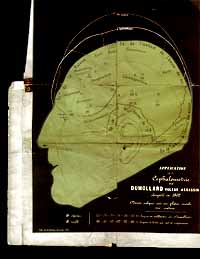
Searching the Criminal Body's historical artifacts come from both private and public collections; many of the objects are on public view for the first time. Nineteenth-century phrenological charts, journals, and illustrations featured alongside phrenological heads made in ivory, porcelain, and scrimshaw are graphic reminders of how pseudo-science permeated nineteenth-century thought and culture. Margaret Bourke-White's photographs taken in the 1930s at Letchworth Village, New York (a civil institution for the feebleminded and epileptic) are poignant examples of society's need to define and contain potential criminal behavior in our own time. Also featured is a special exhibit of vernacular photographs from The Burns Archive, one of the world's largest collections of criminological images. Included are shots from as early as the 1840s of crime scenes, criminal files, penal institutions, law enforcement, and forensic sciences. By bringing together contemporary art and historical artifacts with the goal of the former informing the latter, Searching the Criminal Body supports the final thoughts of Dr. Rafter's recent book Creating Born Criminals (University of Illinois Press), "When we define criminal bodies, we also define ourselves."
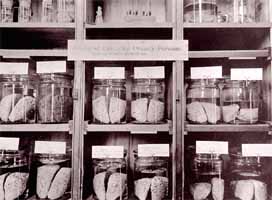
Brains of Educated, Orderly Persons,
(Wilder Brain Collection), late 19th century
Photograph
Original in Rare Manuscript Collections,
Carl A. Kroch Library, Cornell University
The museum's second floor Mezzanine Gallery features ten artists who use a variety of contemporary art practices to investigate the complexities of defining criminal behavior in visual terms. Several artists appropriate the scientist's visual vocabulary in installations that include data, charts, and documentary photography; others take on the voice of the accused by combining invented identities with written text and personal artifacts. At the heart of these artists' investigations is a united attempt to understand and come to terms with the line between criminal and non-criminal behavior. The results are often troubling, sometimes funny, and always provocative.
Among the featured artists are internationally renowned conceptualist, Dennis Oppenheim, political activist, Ellen Rothenberg, University at Albany Assistant Professor of Art, Daniel Goodwin, and two University at Albany alumnae, Lillian Mulero and Michael Oatman. Also featured are Michael Bramwell, Susan Erony, Homer Jackson, Jay Jaroslav, Ruth Liberrnan, and Erika Marquardt.
Public lenders to Searching the Criminal Body include the Mutter Museum, College of Physicians of Philadelphia; Cornell University; National Museum of Health and Medicine Armed Forces Institute of Pathology; New York Academy of Medicine; New York Historical Association, Farmers Museum, Inc.; New York State Museum; Syracuse University Library, Department of Special Collections, and the Smithsonian Institution National Museum of American History.
In conjunction with the University Art Museum's Searching the Criminal Body, The New York Writers Institute will screen a series of six film noir classics of the 40s and 50s during October and will feature a lecture by Ted Conover, author of Newjack: Guarding Sing Sing (2000) on Thursday October 26 at 8:00 PM in the Performing Arts Center Recital Hall.
Other special programming includes a conference organized by the University at Albany School of Criminal Justice entitled Science, Technology, and the DNA Debate on Friday, October 27 and a Downtown Forum organized by the Center for Arts and Humanities.
For further information, including photographs and artist and curator interviews, call or e-mail Corinna Ripps Schaming at (518) 442-4035 or [email protected].
Wednesday through Friday 10 AM–5 PM
Saturday and Sunday noon–4 PM
Closed Mondays and Tuesdays to the public
Visit our WEBSITE: www.albany.edu/museum
FOR IMMEDIATE RELEASE
CONTACT: Corinna Ripps Schaming
(518) 442-4035