By Greta Petry

|
This is a story about persistence.
This seed of interest in how to preserve the Earth�s natural resources existed in biology, but also scattered here and there across the University. Like the hardy goldenrod that takes over the hill that was bare last summer, interest in ecology popped up in sometimes surprising places. At times, it seemed to die out completely, the victim of budget cuts and changing priorities. Tension between what student activists wanted in the late 1960s and very early 1970s and the challenge of creating an intellectually rigorous science program gave the issue visibility but not sustained funding. And yet interest in environmental science always bounced back. Today, UAlbany�s Department of Biological Sciences in the College of Arts and Sciences, along with the Public Policy Program of Rockefeller College, has a successful interdisciplinary master�s degree program in biodiversity, conservation and policy, where it prepares students to work around the world in finding solutions to environmental problems. The biology department would appear to be the logical place out of which to run an ecology program. After all, ecology is the branch of biology that �deals with the relations between living organisms and their environment,� according to the dictionary. That definition assumes a respect for the science of ecology. This wasn�t always the case. Jon Scott, professor emeritus of atmospheric science, contends, �A good percentage of biologists do not consider ecology a science.� He refers to Edward O. Wilson�s book, Naturalist, in which the internationally known sociobiologist and expert on the insect world tells war stories about how molecular biologists snubbed the traditional biologists at Harvard as far back as the 1950s. Wilson writes that James Dewey Watson, the codiscoverer of the structure of DNA, wouldn�t even acknowledge his existence when passing him in the hallway of Harvard�s Biological Laboratories. Watson �arrived with a conviction that biology must be transformed into a science directed at molecules and cells and rewritten in the language of physics and chemistry. What had gone before, �traditional� biology — my biology — was infested by stamp collectors who lacked the wit to transform their subject into a modern science,� wrote Wilson, who received an honorary degree from UAlbany in 1999. At Albany, many had a hand in either a formal or informal program of interest in the environment. They came from disciplines as diverse as biology, art, political science, atmospheric science and history. The late historian Arthur Ekirch Jr., for example, taught a course in the history of nature in America. �It�s really an interest in natural history by intelligent people that fires ecology and, indeed, most of the topics that ultimately come to the fore in biology,� said biologist and professor emeritus Dan McKinley.
Stewart recalled that Leona Rienow decorated a small plastic tree at Christmas. The thought that people were cutting down live trees to put in their living rooms made her �furious,� recalled Stewart. The passion of the Rienows was in tune with the student activism of the day. McKinley said �I suspect that it was just this personal approach to the whole affair (of ecology) by the Rienows that appealed to student enthusiasm, optimism and idealism. They wanted something that used all of the whole person, environmental and human community in a seamless way.� McKinley had an impact on the national environmental movement as a writer and editor. He edited The Subversive Science with Paul Shepard; wrote Environ/Mental with Shepard; and Urban Ecology with Carl George. The Subversive Science received a rave review from Huey D. Johnson of The Nature Conservancy. According to Stewart, The Nature Conservancy, which buys up land with private funds to preserve it, �is probably the prime organization for saving open space in the world.� Unlike the feuding biologists at Harvard, McKinley sent a memo to the deans in June of 1970 encouraging professors across the campus to look beyond �their own narrow windows onto the world,� and to consider teaching courses related to population control, world hunger and preserving natural resources. McKinley was part of the Environmental Forum, a group that hosted weekly speakers on ecological issues. �The Environmental Forum was a great wing ding while it lasted,� he said. �We had local talent like Rienow, Lou Ismay, Ed Cowley from the art department, Stan Blount from geography, Vincent Schaefer and all the talent from people in his Atmospheric Sciences Research Center,� said McKinley. Jon Scott recalled that Lou Ismay, a local artist and high school art teacher, started the forum, hired by Ed Cowley. �Without Ed nothing would have happened,� Scott said. Stewart noted that in addition to McKinley and Rienow, �there was a whole cast of characters who played other parts.� Scott, then an associate professor of atmospheric science, was leading the students. Through the Student Association, he helped the students form a group called the Protect Your Environment Club. Once the Albany students joined, they organized the first Earth Day on campus, according to Scott, who recalled that one PYE president, George Keleshian, later succeeded in getting Ralph Nader to speak at the UAlbany campus. Under President Louis Benezet, who succeeded Evan Collins in 1970, an interdisciplinary program in environmental science began. Scott directed it in the early and mid-�70s. While Scott was in charge, environmental studies was offered through the Division of Social Science. �President Benezet didn�t want environmental studies offered at a university-wide level and I didn�t think it belonged in science since it was a social problem,� said Scott, who added that the history of the environmental studies program at UAlbany would make a whole other story. Whatever its disciplinary location, the environmental studies program was successful in drawing students. �We were second to computer science in FTE (full-time equivalents)/faculty ratio,� Scott said. He ran the program with the help of Lou Ismay and Rosemary Nichols until about 1977 when the program became a victim of funding cuts and changing priorities, along with larger programs like astronomy, nursing and the Allen early decision program. McKinley said a new and promising but struggling history of science department did not survive the cuts either. Meanwhile, back in the biology department, Margaret Stewart, was chairing an environmental sciences program committee. She spent several years working on this, but the program did not materialize after what she surmises were changing administrative priorities. Around 1977, Stewart became involved with a course called World Food Crisis. �This isn�t even my field — I am a vertebrate biologist who works on frogs,� she said. Nevertheless, she was involved with this team-taught course for a dozen years. �Two times I picked up the ball and tried to save programs relating to natural resources,� Stewart said. The second time, resources �were dwindling like mad,� and she and Professor Jerram Brown and others put their heads together in order to come up with a program that would catch people�s attention and draw new faculty funding. (Brown�s book, The Evolution of Behavior, published in 1975, helped pave the way for the explosive development of the fields of behavioral ecology and sociobiology that occurred in the 1980s.) Event ually, with a committee that had input from other colleges in the area, �We drew up a plan for this (biodiversity) program. It was time for a whole new wave. Time to do something sound focusing on biological diversity and the loss thereof,� said Stewart. Former President H. Patrick Swygert offered his support. �Karen (R. Hitchcock), then vice president for Academic Affairs, worked with me. She was a major player in finalizing the program,� Stewart said. But vision and persistence alone were not enough to create a new academic program in a time of less reliance on state government for funding. What finally made it all gel was a private bequest from Harriet Dyer Adams in honor of her late father, the pioneering ecologist Charles C. Adams. The Biodiversity, Conservation and Policy Program continues to need external funding, especially for graduate student support. To donate funds to the program, contact Sorrell Chesin at (518) 437-4770. �Although it took six years before the program in Biodiversity, Conservation and Policy was approved, I felt that it was important enough for me to keep working on it,� Stewart said. �The way I look at it, the goals of the program are going to benefit the world a lot more than a couple more papers on frogs that I might write.� Now that the program is successfully underway with seven students graduated, Stewart will return to her work on frogs, important natural resources. |
|
 Interest
in ecology has existed in one form or another on the University at Albany
campus, stretching back well before the 1950s. Distinguished Teaching
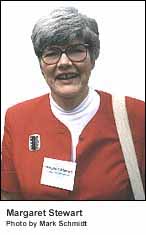
Professor Margaret Stewart, director emerita of today�s Biodiversity,
Conservation and Policy program, remembers that when she joined the faculty
in 1956, her colleague Allen Benton was already teaching a course in conservation biology.
Interest
in ecology has existed in one form or another on the University at Albany
campus, stretching back well before the 1950s. Distinguished Teaching
Professor Margaret Stewart, director emerita of today�s Biodiversity,
Conservation and Policy program, remembers that when she joined the faculty
in 1956, her colleague Allen Benton was already teaching a course in conservation biology.
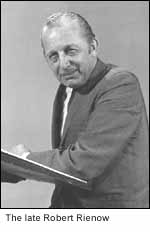 The late Robert Rienow, a professor of political science and
Distinguished Service Professor, was �an early force in shaping the environmental
movement in the U.S.,� noted the Times Union in an article
about Rienow�s death in a tragic house fire. In that 1989 article, Jon Scott
was quoted as saying, �a lot of the questions about the environment today
you can find in Bob Rienow�s books 20 years ago.� Rienow and his wife, Leona
Train Rienow, wrote the best seller Moment in the Sun in 1968.
The late Robert Rienow, a professor of political science and
Distinguished Service Professor, was �an early force in shaping the environmental
movement in the U.S.,� noted the Times Union in an article
about Rienow�s death in a tragic house fire. In that 1989 article, Jon Scott
was quoted as saying, �a lot of the questions about the environment today
you can find in Bob Rienow�s books 20 years ago.� Rienow and his wife, Leona
Train Rienow, wrote the best seller Moment in the Sun in 1968.