By Carol OlechowskiA three-year Andrew W. Mellon Foundation grant totaling nearly half a million dollars will build on the already strong research expertise of the University�s China scholars while launching an initiative to expand research endeavors in that area.
The $480,000 grant will support development of an Urban China Research Network, a multidisciplinary, multi-institutional network of scholars who conduct and support research and training activities focused on migration within contemporary China and its impact on urbanization. The program will facilitate the exchange of information among researchers at Albany and the other institutions collaborating on the effort, and provide incentives for interdisciplinary and international scholarly collaboration. In addition, the Mellon grant will add significant funding for research projects supported by the network and foster institutional development within the participating centers in China.
According to Vice President for Research Christopher F. D�Elia, �the receipt of this prestigious grant from the Mellon Foundation underscores the enormous strength we have in the social sciences at our University. The Albany faculty leading this effort are among the nation�s finest researchers in their fields.�
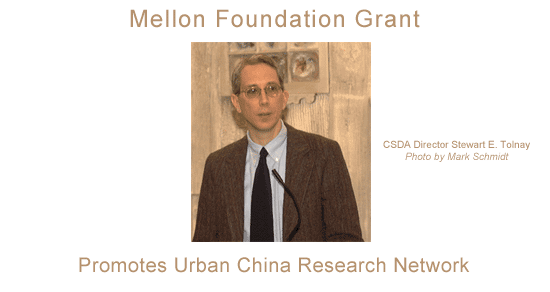
The Mellon Foundation award, says Center for Social and Demographic Analysis (CSDA) Director Stewart Tolnay, �will make the University at Albany a major player in the study of internal migration and urbanization in China. Only nine such awards were given by the foundation to study population movements in less developed countries, placing Albany alongside such outstanding research institutions as Princeton, the University of Pennsylvania, Brown, and the University of North Carolina.
�Having the Urban China Research Network anchored here at Albany will also provide our faculty and students an opportunity to be at the cutting edge of research into these important topics. Furthermore, the results of the scholarship produced by the network will inform policy makers in China as they contend with the massive movement of people from the countryside to the city, and with the many consequences such migration has for the urban environment.�
As a �virtual center,� the Urban China Research Network will bring University researchers together with their colleagues on three continents.
International advisory board members at Albany will include the Department of Sociology�s John Logan, Christopher Smith of the Department of Geography and Planning, and Jennifer Rudolph, Department of History. University sociologists Glenn Deane, Nancy Denton, William Frey, and Scott South are expected to participate, as is geographer/planner Ray Bromley, notes Tolnay, a sociology professor who will also lend his expertise to the network.
Other U.S.-based board members will include faculty at the University of California, Irvine; Virginia Commonwealth University; the University of Washington, Seattle; Queens College of the City University of New York; the University of Chicago; and the University of Southern California. Faculty representing the fields of sociology, urban planning, anthropology, and geography at foreign institutions, including Hong Kong University; the University of Liverpool, England; Canada�s universities of Calgary and British Columbia; and the National University of Singapore�s East Asian Institute, will also participate.
The proposal to develop the Urban China Research Network grew from a recognition that, during the past 20 years, �China has experienced a number of parallel and interrelated transformations,� says Smith. �The transition from a socialist economy to one that is market oriented is both a result of the country's reform process and a catalyst� that has privatized China�s farms, encouraged peasants to become entrepreneurial, stimulated internal migration, and spurred rapid urbanization. As a result, industrial and enterprise reforms in municipal areas have made China a player in the international marketplace, a leading exporter of manufactured goods.
With economic reforms and the rapid increase in urbanization giving rise to �a wide range of social and economic changes in lifestyles, attitudes, and behaviors,� notes Tolnay, �we have an extraordinary opportunity to conduct research focusing on policy.� Initially, network research themes will include such topics as urban morphology and spatial reorganization, the dynamics of rural-to-urban migration; the operation of urban labor markets; housing and settlement patterns of migrants; and changing lifestyles and behaviors of migrants in the cities. These topics, in turn, relate to �migration and urbanization-related policy issues currently being debated in China, including policies related to housing, neighborhood development, social service delivery, urban planning, public health, and criminal justice,� Logan adds.
Network participants will carry out their research through institutional exchanges of faculty, fieldwork in China, and funding to support graduate student research. Each year, researchers will gather at the University to review their progress to date and to determine the direction their future efforts should take. In addition, data will be made available through a special project Web site.
Albany will supplement the Mellon grant with funding of $324,900 over three years. The University contribution will support a half-time programmer /analyst who will create and maintain the network Web site and ensure that archived data is available to network members. It will also cover a portion of the facilities and overhead costs.