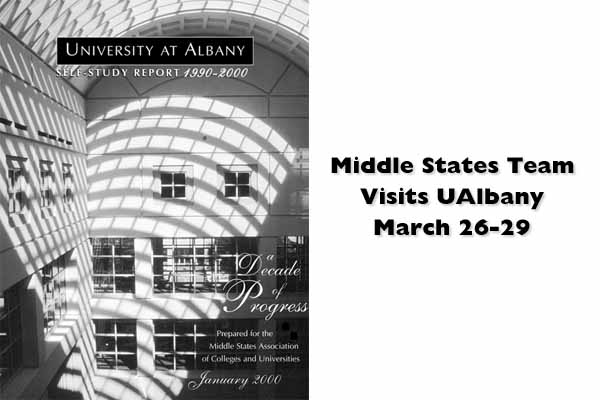
By Greta PetryThe Middle States Commission on Higher Education is sending a site team to visit the University at Albany campus March 26-29. The nine-member site team will be chaired by Freeman A. Hrabowski, president of the University of Maryland, Baltimore County.
In preparation for the visit, the University has completed a Self-Study Report. This report represents the input of more than 100 faculty, staff members and students who were involved in 10 committees overseen by Sue Faerman, dean of Undergraduate Studies. The committees did the bulk of their work last spring.
�Over the next few weeks, we will be seeking to increase awareness about the site team visit and to let the University community know that the Self-Study Report is available,� Faerman said.
During the Middle States visit, site team members will be meeting with University community members. The visit and the report are part of an accreditation process that takes place once every 10 years. The new report takes into account the sweeping changes and tremendous growth that have occurred on the UAlbany campuses in the last decade.
In a message to the University community, President Karen R. Hitchcock said, �The March 26-29 Middle States Association Evaluation Team�s visit and review of the University at Albany are of critical importance, not only to our essential academic accreditation, but also to the continuing development of our institution, to the national credibility of our achievements and aspirations, and to the expanding recognition and regard that higher education across the country has for this institution. The University�s last 10 years have been truly transformational, and I think you will find that our Self-Study Report is a compelling chronicle of a decade of growth and achievement in which each of us should take pride. Our comprehensive Self-Study Report can be fully accessed through the University�s Web site home page, and I highly commend it to your attention. It, after all, is a chronicle of your accomplishments in teaching, in research and in service.�
A university going through the accreditation process has the choice of a comprehensive or a focused review. A decade ago the University chose to conduct a focused review of the strategic planning and budgeting process then being pioneered by former President Vincent O�Leary, Faerman said.
�Given the tremendous progress and growth we have made under former President H. Patrick Swygert and now President Hitchcock, we felt it would be better to do a comprehensive study looking at all areas of the University,� Faerman said. �In addition, we had just completed the Master Plan process and were coming to the conclusion of a campuswide account of a plan charting the future as well as being engaged in the Mission Review process with SUNY Central. We felt it was a good time to take this comprehensive review of the campus.�
The �Executive Summary� section of the report highlights five key themes that emerged as challenges the University faced during the past decade:
- �To continue, indeed to seek to accelerate, the University at Albany�s development as one of the nation�s premier public research universities at a time when public institutions of higher education, nation-wide, were finding it essential to diversify their funding base.�
- �To continue to strengthen the University�s research and graduate education programs, particularly in disciplines that are critical for enhancing the institution�s national stature as a center of excellence and for contributing to our region�s and state�s quality of life and economic vitality.�
- �To establish Albany among SUNY�s most selective undergraduate institutions.�
- �To address a long-standing disparity between the needs of the academic and research programs and the capabilities of the institution�s facilities.� The report details improvements that have been brought about by the Master Plan, plus the building of four new facilities on campus (the Campus Center Extension, the Recreation and Convocation Center, the Center for Environmental Sciences and Technology Management, and the new library) over the last decade.
- �To rededicate ourselves as a campus community to socially responsible participation in our larger communities.�
The Middle States� evaluation will be based on the Self-Study Report, as well as the findings and observations the site team members gather from their visit to campus, Faerman noted. �They will be scheduling meetings with key constituencies, administrators, faculty and students, as well as taking the opportunity to simply walk the campus and talk with people,� she said.
The team is made up of people with expertise in the broad areas covered by the report. Faerman said, �Ultimately, if you think of the big picture, they are going to be looking at these questions: Do we have good planning processes in place; do we follow our planning processes; and do we meet the goals that we set in those processes?�
Those with comments or questions about the Self-Study Report or the Middle States accreditation process may contact Faerman in the Office of Undergraduate Studies at 442-3950, or Robert McFarland in the Office of the President at 442-5400.