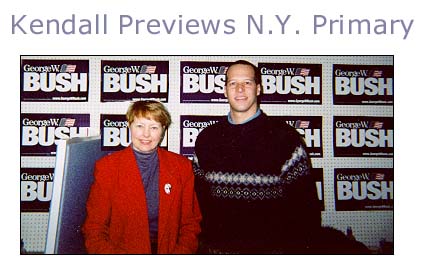
By Carol OlechowskiWhen the results were tallied for the Republican contenders in the February 1 New Hampshire primary, reporters and politicos alike were stunned when Arizona Senator John McCain snatched victory from the candidate generally expected to win, Governor George W. Bush of Texas. One observer who wasn't taken by surprise was Kathleen E. Kendall of the University at Albany's Department of Communication.
In fact, Kendall cautioned as long ago as last July 4, in an opinion piece for the Times Union, that �victory for Bush is far from certain.� Wrote the highly respected teacher and political observer: �The Republicans appear to think that by uniting behind the front-runner early, they can mount a confident and winning campaign. But they are forgetting the primaries.�
Kendall herself definitely did not forget the primaries. As she has every four years since 1988, Kendall also hit the campaign trail, so to speak.
She spent the last nine days of the New Hampshire primary campaign conducting research for an intensive analysis of communication in the Bush campaign. Carrying a press pass from WAMC, a National Public Radio affiliate in the Capital Region, Kendall attended ten Bush events, watched the candidate speak, and interviewed members of the press. She also did three interviews with NPR.
In addition to observing Bush herself, Kendall wanted to gauge public reaction to him. �A graduate student distributed questionnaires at three Bush events so that I could see what people thought of his communication before and after the event. I also collected newspapers covering the events, and arranged for the videotaping of network news coverage and of coverage by New Hampshire TV station WMUR. I wanted to provide a thorough analysis of the �struggle for interpretive dominance� among the three main participants in any campaign: the candidate, the media, and the voters,� recalls Kendall. She will share her research findings in a paper for the National Communication Association convention in Seattle next fall.
�I was impressed by Bush�s large and efficient organization,� she notes. During her stay, however, she also had the opportunity to observe McCain on several occasions. �He was in New Hampshire 65 days and held 114 town meetings all over the state,� Kendall explains. That particular forum �allowed McCain to reach many people and keep his campaign going despite the fact that he didn't have much money.�
The two candidates �were very different in their presentations,� observes Kendall. �McCain comes to an event with everyone knowing he was a prisoner of war in Vietnam for five years; his book has given him a lot of attention. He is very quiet. McCain speaks for about 20 minutes, then answers questions. He lets the audience ask many questions — that's a risky thing to do, allow the audience to define the agenda — and I think it builds admiration and makes the candidate seem confident. McCain answers questions in a clear, informed way. And he often admits, before responding to a question, that the audience may not like his answer.�
Bush, on the other hand, �is dynamic in his delivery but more vague in the statements he makes. He talks about taxes, education, and parenthood. In fact, Bush speaks about parenthood a lot — about how it's the most important job anyone can have,� says Kendall.
�All the candidates like to be seen as fighters,� she adds, �and it seemed to me last year already that McCain was going to have the mantle of �fighter� placed on him by the media. He describes himself as a �maverick,� and he was a navy pilot and a war hero, so, in a literal sense, he is a fighter.� McCain�s repeated attempts to make campaign finance reform a reality have enhanced his feisty reputation. So did his ultimately successful bid to be placed on the ballot in New York's March 7 primary, which Kendall characterizes as �a David vs. Goliath media story.�
As the campaign in New Hampshire continued, polls showed McCain closing the gap with Bush. �I thought McCain was going to win, but I had no idea he was going to win by so large a margin — 19 points,� Kendall notes.
New Hampshire is small; most of its 1.2 million residents live in the southern part of the state, Kendall points out, and it is �not very diverse and not at all urban.� Still, the Granite State is significant in terms of presidential politics: In nearly every primary since 1952, New Hampshire voters �have been prescient� in predicting which candidate would eventually become president. (The one exception was the 1992 contest; the late Paul Tsongas, a Senator from Massachusetts at the time, won that year. Bill Clinton placed second.)
The people of New Hampshire take their responsibility as voters seriously, according to Kendall. �They have a reputation; they see themselves as sort of an advance guard for the rest of the country. They enjoy the speeches, the debates, and the handshaking, and they expect the candidates to answer their questions. New Hampshire schoolchildren are even encouraged to study candidates and ask questions.�
After the February primaries in Delaware, South Carolina, and several other states, the candidates� next stops will include New York. Kendall is pleased that voters in the Empire State will go to the polls earlier this year for the presidential primary. Previously, New Yorkers cast their primary votes in April, and by that time, many of the contenders had dropped out of the race. �I�m glad New York is going to be part of the decision this time,� Kendall says.
By mid-February, Gary Bauer and Steve Forbes had already bowed out of the campaign. What does Kendall foresee for March 7?
�New York could be the graveyard of some of the candidates,� she predicts. �It will be do-or-die here for Bill Bradley. Al Gore is organized and very well known; he can count on the support of the state's Democratic party leaders. But Bradley has the advantage of coming from an adjoining state (New Jersey) and of being a sports star. If McCain wins South Carolina, then the strength of the Bush campaign will diminish, and it will be a hard-fought race in New York. I think McCain will win here. But New York doesn�t allow Independents to vote in primaries, so I�m probably wrong!� Kendall laughs.
In the meantime, Kendall urges her fellow New Yorkers to prepare for Primary Day: �There�s still time to look at the candidates.�