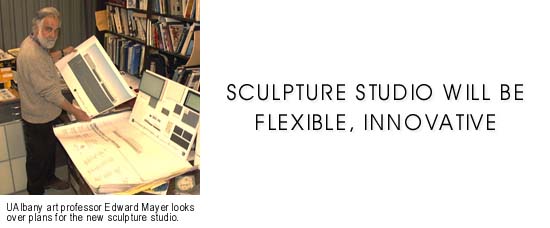
By Christine Hanson McKnightSculpture, says Edward Mayer, can be a noisy, messy business. At the moment, the noise and the mess are largely confined to a leased, warehouse-like facility about two miles from the main campus that serves as the University's sculpture studio. But that will soon change as the University prepares to break ground in March on a new sculpture studio on the eastern edge of campus that is within walking distance of the academic podium. The $3.8-million studio, which is part of the University's $130 million master plan, is scheduled to be in use by the fall of 2002. Construction bids for the project were opened January 18.
Mayer, who heads Albany's sculpture program, also had a hand in planning for new sculpture facilities at both Ohio University in Athens, Ohio and Carthage College in Kenosha, Wisconsin before he joined the University at Albany Art Department faculty in 1983. But the current project, he says, is more complex and exciting.
Sculpture is, by definition, about space, Mayer explained. �The research that goes into making it involves a variety of materials and techniques. It is the most inclusive of art disciplines, wherein work can be large or small; it can be on or off the wall, incorporate two- or three-dimensional imagery, and might require painting and a projection screen, as well as speakers and a video monitor,� he said. Some sculptors, he added, carve stone, while others model clay and pour molten bronze or fold paper. They make molds, weld steel, cast and laminate resins, work in reinforced concrete, and incorporate motorized, kinetic, electronic, acoustic and digital media.
Sculptors require experimental exhibition space in which to test lighting and installations, as well as task-specific shop areas, such as a foundry, wood shop, plaster and mold-making rooms and well-ventilated and -illuminated areas for welding, sanding, spray painting and resin applications. The materials used need delivery and storage capabilities, as well as assembly areas. Completed work requires temporary storage, while rejected work and refuse need to be removed.
The new facility, Mayer says, takes all of these needs into account. The one-story, 20,000-square-foot building will house all sculpture and three-dimensional activity for the Art Department from freshmen to graduate students. In addition to high-ceilinged, individual studio/offices for faculty and students in the Master of Fine Arts program, it will feature a beginning sculpture/figure modeling classroom, a group studio for sculpture majors, a media suite with video imaging equipment, an experimental gallery/installation area with track lighting which will also be used for lectures, a three-dimensional design room, a foundry/metal working area with an overhead rail system that will make it possible to move heavy objects, and an outdoor work pad for assembling and loading large-scale art work and material.
�The stress isn't on a material or a process, but rather on the conceptualization of how to bring ideas to life in a workable, safe environment,� said Mayer, who, along with sculpture technician Roger Bisbing studied programs at Syracuse University and SUNY campuses at New Paltz and the University at Buffalo in planning Albany's sculpture studio.
The design of the sculpture studio will also have state-of-the-art ventilation and be directly connected to campus telephone and data systems. The location within sight of the podium will address concerns for the personal safety and security of students.
The sculpture studio will be the first academic building on the main campus that deviates somewhat from the original podium design by Edward Durell Stone. The structure has a clean, cool, industrial look with exterior walls of manganese ironspot brick, metal wall panels and zinc cladding. The windows will have a blue-green tint, while skylights will be translucent.
The building is located on a site that will accommodate construction of a second building at a later date, thus permitting the eventual consolidation of the art department in one location. The department now has 136 undergraduate art majors and 40 M.F.A. students. Of those, about 35 to 40 undergraduates and 11 graduate students are working in sculpture.