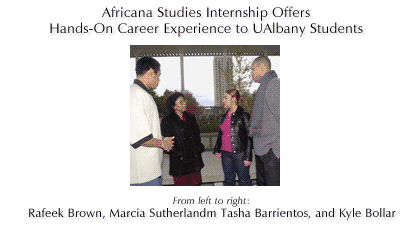
By Greta Petry
Rafeek Brown, 23, of Elmira, who will be a senior this spring, works at the Albany County Jail with inmates ages 16 to 20 while he gains experience for a future teaching career. He also works with youth who are on out-of-school suspension.
Kyle Bollar, 21, a UAlbany senior from Huntington, N.Y., is researching the Underground Railroad. He is focusing on two settlements: Eagles Nest in Ulster County, and Success, formed by fugitive slaves and abolitionists in Nassau County. When finished, his findings will be a part of the New York State Freedom Trail Program study, aimed at creating a curriculum about the trail in grades K-12 for the State Education Department. Like Brown, Bollar has his eye on a teaching career.
Tasha Barrientos, 19, a junior from Syracuse, N.Y., transports women who are escaping from abusive husbands or boyfriends. She meets them at a gas station or other location and takes them to the Equinox safe shelter, the address of which remains confidential for security reasons.
Engagement with the community is nothing new for Barrientos, who was named Volunteer of the Year while still in high school for her work with the Special Olympics.
Tracy Jordan, 19, a junior from Brooklyn, N.Y., advocates for battered women in Family Court. She helps them fill out petitions for orders of protection, support, and custody, and guides them in letting their lawyers know about information pertinent to their cases. Her career goal is to become a lawyer, and then a family court judge, handling divorce. Jordan, a native of Barbados, says law is a tradition in her family: A distant cousin once served as the prime minister of Anguilla, a self-governing territory in the West Indies.
All four of these UAlbany students are gaining hands-on experience in their future careers while giving their time and energy back to the Capital Region through the Department of Africana Studies� Community Service Program directed by Marcia Sutherland. Sutherland, an associate professor in the departments of Africana studies and psychology, takes great care to match students to internships tied to their professional goals. And while this experience is a resum�-stengthener, there is more to it than just enhancing one�s career prospects.
�I tell the students, before they are sent anywhere, that they are ambassadors for the University at Albany, and that they have a responsibility to make a good impression so that we will be able to send other students to those agencies in the future,� Sutherland said. �When we consider our University mission — it is linked to having a relationship with the community. The Department of Africana Studies� Community Service Program is really tied to that community in a relationship that benefits the community, the students, and the University.�
Since the 1970s, community service has been a part of the Africana Studies program, one that has grown over the years.
�Right now we are working on reaching a long-term agreement with the Freedom Trail Program,� Sutherland said. Under this proposal, UAlbany�s graduate students in Africana Studies may be able to one day earn a partial tuition waiver while they document the authenticity of sites along the Freedom Trail, as part of the process of developing a K-12 curriculum for the state.
Through the three-credit internship, majors, minors, and graduate students in Africana Studies can work with the Homeless & Travelers Aid Society of the Capital District; Albany County Head Start; Equinox; The Center for Law and Justice; Adolescent Employability Skills Plus Program, Inc.; and the Executive Chamber, as well as in a host of other governmental and non-profit agencies.
Internships are open to students who have junior standing and a cumulative GPA of at least 2.5. The student must be sponsored by a full-time faculty member.
In addition to the project, students must fulfill an academic component to complete the internship. �They have to write an academic paper that uses the scholarly literature, addressing both theory and empirical statistical data. Then they must infuse the scholarly literature with their own experiences from the agency,� Sutherland said. �This is a very important component of the internship courses. They must meet with me once a week. I supervise the academic component of the program. I make sure things are running well.� Supervisors evaluate the students twice, once at mid-terms and again at the end of the course.
For Brown, working with young offenders who are in jail for selling drugs or for assault means showing them they can take another path. Having volunteered to join a 12-step program to make positive changes in their lives, many say they want to go back to school.
�I just try to be a role model for them. They see me, and I am 23, and they know that I am in college. So hopefully, they look up to me. I tell them if I can do it — they can too,� said Brown.
Brown�s internship is with the Adolescent Employability Skills Plus Program, Inc., 69 Lexington Ave. in Albany, which seeks to prevent incarceration and reduce recidivism rates for at-risk youngsters by providing early intervention. Students suspended from elementary or middle school also meet with Brown at the AESPP office.
�I have always wanted to be a teacher,� he said.
Bollar�s job is to follow up on leads about slavery�s hidden history in New York State. He has found that his internship requires a greater commitment than the eight hours a week he spends at the Office of Cultural Education at the New York State Museum.
�I take work home with me all the time. I carry the commission report around. It tells you how to find information about the trail. They gave us the foundation and we build on it,� Bollar said.
The study�s executive summary noted: �Enslaved Africans, running away from slavery in New York State from 1625 to 1827, sought refuge outside the state, in Native American communities and in urban areas. After 1827 when slavery was abolished in New York, fugitive enslaved Africans from outside the state looked to black and white New Yorkers and New York State for passage to safer freedom zones, refuge, and protection from slave catchers up to the end of the Civil War in 1865. Places of refuge and assistance, sites of significant events and struggles of resistance, and participants in this struggle for freedom beginning with the enslaved Africans themselves deserve broad public recognition, awareness, understanding, and commemoration.�
The commission�s program is based on a year-long study conducted by the Schomburg Center for Research in Black Culture of The New York Public Library.
�It�s just fascinating how much information is out there if you do the research,� said Bollar, whose career goals include being a teacher, a guidance counselor, and eventually, a principal. He is considering Teach for America, through which young teachers volunteer for service in one of 15 of the nation�s poorest areas, from New York City to rural Louisiana. Another part of Bollar�s internship is helping to compile the African American Resource Guide for the New York State Museum, which has meant contacting organizations all over the state.
Barrientos plans a career in law. �My mother always told me it is important to help others out. As much as we complain about little things in our lives, it could be so much worse,� she said.
At the battered women�s shelter, �I am there to support them. They are coming from bad situations to live among strangers, and that makes them uncomfortable at first. I also work with their kids,� she said.
While Barrientos helps the clients settle in at the shelter, Jordan explains the process to them in court. She can assure them their addresses will not be revealed to the respondents in court papers; can counsel them to have the landlord change the locks while they are awaiting a permanent order of protection; and can suggest options if they are dependent on their spouses for financial support.
While Jordan�s internship will end in December, her immersion in law will not. During the winter break, she will earn three credits working in the District Attorney�s office in Brooklyn. Next summer, she plans to study abroad in South Africa.