By Greta PetryThere are numerous documented stories of heroism among the 3,000 veterans associated with the University at Albany. Francis "Howie" Anderson�s is one. Anderson, of Glenmont, is a former student from UAlbany (then the State College for Teachers) who served in World War II. His story was sent out over the Associated Press wire from Tunisia in February of 1943. Today he is a retired professor from Albany Law School, where he still teaches the occasional class. Anderson attended the State College for Teachers from 1938 until 1941, when he transferred to the University of Chicago.
"I received a wonderful education while I was at the State College for Teachers," Anderson said. He transferred when he realized that teaching history, his original goal, was just not for him. Professor Donnal Smith in the Social Studies Department made a call to a colleague at the University of Chicago, and assisted him in transferring and obtaining a scholarship. Anderson later became a lawyer and taught at Albany Law School for more than 32 years, retiring in 1990 "after 65 semesters." While officially retired, he is nevertheless teaching a course on criminal procedure this semester.
He was a 23-year-old private from Nelliston, N.Y., serving in North Africa during the first American campaign against German troops in World War II, when he walked through 100 miles of enemy territory with two other American soldiers to escape Gen. Erwin Rommel�s forces in February, 1943. The three soldiers were "the first group to reach the American lines of units which for three days and two nights were surrounded by the Germans on Djebel Ksaira Mountain, six miles south of Faid," the wire story noted.
Anderson said he didn�t talk much about his experience until about five years ago. "If you had called me ten years ago, I would have told you to get lost," he said.
But now, as the number of surviving WWII veterans dwindles, Anderson, 80, sees the value in sharing his story.
He was a lowly private in Tunisia, a country in North Africa on the Mediterranean, serving in a reconnaissance unit of the U.S. Army. His job was to drive one of the lieutenants around.
One night after the unit had taken some enemy fire during the day, the officers decided to stay put. Anderson went to his sergeant and asked to go out and look around on reconnaissance.
The sergeant responded, "Go ahead. We�ll pick up your bones in the morning."
Anderson left the platoon. While he was out scouting in the dark, he stopped to position himself behind a mound of dirt. "Put your hands up in the air," said a male voice in German.
Instead of complying, Anderson "ran like hell and I didn�t stop running for two kilometers. I knew the Germans were there." He wanted to run back and warn his company, but in his fear and haste, missed the right hill. The Germans attacked the next day and most of the men in Anderson�s company were captured.
For the next two days he walked along a mountain range and an arid valley, keeping himself hidden from the Germans, who were mainly in vehicles, not out on foot patrol.
"By now I�d had no sleep or water or food for two days. I was in bad shape. My mind was not working. I had my knife and Tommy gun," he said. He ran into several Arab men who ended up taking his Tommy gun and knife away, but who let him go unharmed.
Not long after this, another Arab man by a hut waved to him.
"I was just about at the end of my rope. Instinct said to go ahead, even though the last Arab I�d met had taken my gun. He hid me in the hut and I fell asleep," said Anderson.
Then, suddenly, Anderson�s new Arab friend pulled two more American soldiers into the hut.
"One of them was Leo Raymond of Frenchville, Maine, whose parents were French Canadian. He speaks French. This is the best break of my life because he can communicate with the Arab," Anderson said.
Luckily, Anderson had stumbled into the hut of a man who had been badly mistreated by the Germans while serving in the French Colonial Army. The man was taking a great risk by hiding Americans, and could have been killed by the Germans.
He gave directions to the next pass through the mountains.
The three U.S. soldiers went on together from there. Their boots were worn out and their feet, blistered. It was cold at night and they slept fitfully, with leaves their only blanket.
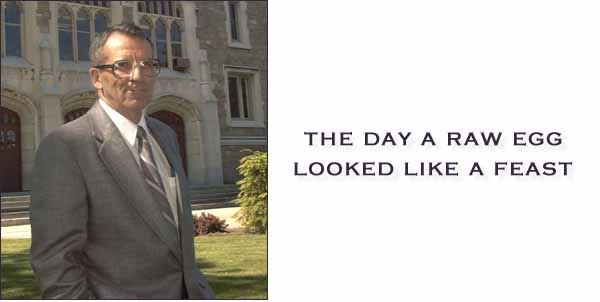
"We drank water out of the mud puddles," Anderson said. At one point, they stopped at an encampment of families living in tents. Once again, Leo Raymond conversed in French with the family, who fed them a meal of raw eggs and unleavened bread.
"I�ve never eaten a raw egg before," Anderson said. "But I tell you it was great. And we had unleavened bread that the sand had gotten into during the baking. But it was great."
Resuming their journey toward American lines, they finally saw the main road, occupied by German traffic.
"We waited until dark, scooted across, and we found a French farm. They were old line Colonialists and you had to be careful, because many Colonialists didn�t care for Americans. We lucked out. Leo talked to them and they gave us bacon, bread and something to drink," Anderson said.
A man who worked for the family led the young soldiers up the mountains at night. The next morning they awoke to the sound of traffic. This time, they were hearing American vehicles. The soldiers were at Kasserine Pass. They had been walking, surrounded by the Nazis, for three days and two nights.
"You should have seen us scramble for that road. When we were safe behind the American lines we had food and coffee. I slept for 17 hours straight," Anderson said.
When Anderson returned to his unit, he found that only 13 men remained out of roughly 160 soldiers. Most had been captured.
Replacements were brought in; the unit was back fighting within the month.
While his long walk in North Africa was an ordeal, Anderson said his later service in Italy was more difficult. By then Anderson was a 2nd lieutenant in charge of 20 other men. He and Technician Selmer A. Frettem of Kenyon, Minnesota, were later cited for advancing in the face of enemy fire at Serra di Gatto, between Florence and Bologna. He remembers carrying a wounded soldier to safety. For their bravery the two men were awarded the Bronze Star.
"I�ve never regretted my military service. It taught me an awful lot about human beings, about leading men, and about how far you can push people," he said.
Anderson lost his younger brother John during the war. John died in action serving on a submarine in the Pacific Ocean.
"We were only 18 months apart. We were very close," he said.
Anderson�s war record is not the end of the story. In 1973 he was honored with a citizen valor award by former Governor Nelson A. Rockefeller for stopping a bank robbery in progress in the city of Albany.
"He (Anderson) immediately stopped his car and blocked the escape route of one of the robbers. He managed to capture another bandit who was fleeing the scene. He held the culprit until the police arrived. Professor Anderson then helped the police catch the second robber. He acted at serious risk to his life," stated the press release from the governor�s press office announcing the award.
Anderson credits his military training with preparing him to stop that robbery.