hirty years ago, the thought of curing illness or disease by zeroing in on one of the human body�s 100,000 or so genes would have been as far off as landing a man on Pluto. Today, the prospect is not only within our solar system, it is within our own backyard � at the Center for Comparative Functional Genomics on the University at Albany�s East Campus.
The dramatic progress in genetics research was signaled last June with the announcement that scientists had succeeded in completely sequencing the human genome � the three billion chemical characters that comprise the blueprint of human life. The deciphering of this vast genetic archive has set the stage for a new phase of research, already getting under way at UAlbany in a collaborative project with industry and government.
"Now that this sequence information is known, we enter a new phase of scientific discovery: the �post genomic� world," said UAlbany biologist Paulette McCormick. "Here, it will be necessary to unravel how each and every one of the approximately 100,000 genes that have now been identified actually works within the context of the body."
A new discipline, "functional genomics," has brought science to the threshold of great diagnostic and therapeutic discoveries. McCormick and fellow Albany biologist Al Millis have spent the last three years positioning the University to play a major role in this new research. With the enthusiastic support of President Karen R. Hitchcock, they recently established the Center for Comparative Functional Genomics (CCFG).
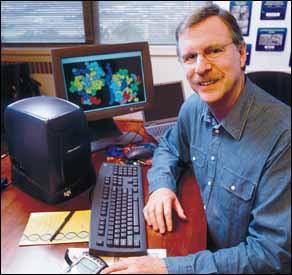
Photo by Gary GoldUniversity biologist Al Millis carries out his research at a Silicon Graphics workstation which is capable of high-resolution molecular analysis. The high-tech equipment was purchased with the support of a $5 million state grant. Among the initiatives at the 4,500-square-foot CCFG is a Mutant Mouse Regional Resource Center (MMRRC), funded at $4.5 million over five years by the National Institutes of Health (NIH). The MMRRC, one of three in the country, is part of a determined nationwide effort by the NIH to maximize the mouse as a model for disease and extrapolate findings to humans. Serving as co-principal investigators of the mouse project are McCormick and James Geistfeld of Taconic Farms, Inc., an international supplier of disease-free mice for laboratory research.
"The big genome sequencing centers have provided us with a book of three billion characters in 100,000 words and with some clues as to their literal translation," said McCormick. "But now it�s up to the rest of us to arrange those words into sentences, and the sentences into paragraphs, and the paragraphs into chapters that make sense in the book of life.
"We need to translate all of this information into the vernacular to understand the idiomatic nature of the products of these genes � most likely proteins � and how they function within the living, breathing being."
"The maximal benefit that can be derived from knowing the complete human genome is limited," said McCormick, "because genes cannot be manipulated in humans � for instance, deleted, inserted, mutated � to see what kinds of changes will result. Instead, we must use other organisms to see what effects and heritable changes in DNA � effects and changes known as �mutations� � will have on those organisms. Those effects will then be compared with those in other organisms, and on and on, until eventually we can extrapolate what the effects will be on human beings."
Even 15 percent of the genes or proteins from the lowly yeast have matches in DNA or protein sequences � known as homologs � in humans. For creatures like fruitflies and worms, this figure is even higher. But the mighty mouse is the closest working model science has to the human being. The NIH, recognizing the mouse�s importance, recently instructed that all human genome sequencing facilities redirect a substantial portion of their efforts to the mouse genome.
It made for a natural fit for McCormick, who for years has used the mouse in genetic studies of cancer and metastasis, as well as embryonic development. In addition, one of the industrial tenants sharing the East Campus with the Center for Comparative Functional Genomics was Hudson Valley-based Taconic Farms, with whom McCormick had already established a working relationship as a consultant.
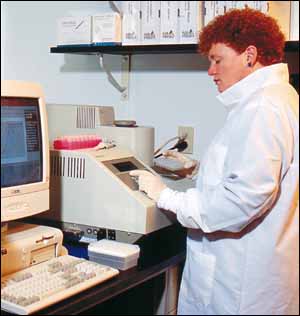
Biologist Paulette McCormick uses a polymerase chain reaction machine (PCR), which measures real-time PCR for quantitative DNA analysis.
Photo by Gary GoldWith McCormick and Taconic�s Geistfeld as co-principal investigators and another University mouse geneticist, Lorraine Flaherty, from the School of Public Health, serving as consultant, the team made its grant proposal to the NIH in 1999. Last February, the team received word it would become one of the nation�s three Mutant Mouse Regional Resource Centers, with the others to be located at the University of North Carolina at Chapel Hill and at the University of California at Davis.
McCormick said that researchers all over the world � including at UAlbany�s new transgenic mouse facility, which McCormick directs � are making mutant mice, targeting specific genes and asking what effect having too much, or too little or even none of one specific gene product has on the mouse�s health.
"But it�s costly and very labor-intensive to maintain and characterize these mice," she said, "and so our first task is to import the mice, develop pure strains and cryopreserve their embryos and sperm for future use. We also need to standardize the kinds of tests that are used to study them and to characterize them in new ways."
ith the Center for Comparative Functional Genomics� newly obtained microarray technology in hand, the Center�s researchers will study global gene expression patterns in mice. "You can �knock out� one gene that you think might predispose someone to cancer, for example, and then look to see if the mouse gets cancer," explained McCormick. "And, if it does, then we�ve learned something.
"But to combat that cancer, you have to know how loss of the gene caused the cancer. Knowing that the gene is gone isn�t enough, knowing how its loss changed the expression of other genes to create the problem is what�s critical. So for that you have to be able to look at all the genes that are active in the cells to find any changes."
In the past, that was nearly impossible. One could only study one gene or a small subset of genes at a time. "But with microarray analysis, you can put thousands of genes on a single chip like a computer chip, so that on just five to ten chips, you have all 100,000 genes arrayed. When genes are active in a cell, they make a complementary product called RNA, and because of the complementary nature of the RNA, it will bind to the DNA of the gene from which it was made. One simply takes the RNA from a cell and lets it bind to one of the DNA computer chips. If the gene is active in that cell, you�ll get an RNA-DNA match. If not, no match. So RNA from kidney will match with some different genes than RNA from liver, and it will be these genes, then, that will determine that some cells become liver and some instead become kidney, McCormick said.
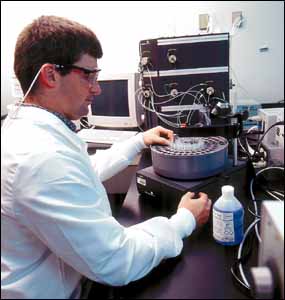
Photo by Gary GoldEast Campus laboratory manager David O'Hehir operates a high-pressure liquid chromatography machine, which uses high pressure to separate mucleic acid or peptide molecules. "Our plan is to study normal gene expression patterns in the mouse and then compare them with those created by a variety of mutations. Maybe in this way we�ll be able to find a gene that�s critical to all different types of leukemias or to many types of behavioral problems, etc."
Of the three MMRRCs named by the NIH, Taconic/UAlbany�s is the only one that is an industry-university collaboration. "There are several advantages to this," said McCormick. "For one, it allows us to share Taconic�s knowledge on mouse husbandry, pathogenicity, cryopreservation, etc. They are the real experts in this field. The other universities will have to contract out some of these services. Conversely, Taconic gets to share our knowledge of, and equipment for, the study of molecular genetics.
"And finally we both get to benefit from the other�s mindset."
Taconic�s Geistfeld agreed. "This center shows that cooperation between academia and industry can work to the benefit of biomedical sciences. The valuable information that will result will impact the development of cures and preventive measures for what are now incurable diseases."
New York State has become an important partner in this venture as well. Senate Majority Leader Joseph Bruno was instrumental in obtaining the East Campus laboratories for the University, and included in Gov. George Pataki�s 2000 executive budget was a $5 million state grant to the Center for Comparative Functional Genomics, including $2.8 million for core facilities for the center. Some of that money was used to purchase the equipment for the microarray analyses.
"The microarray facilities have been pivotal," said McCormick. "Without them, we probably would not have gotten the $4.5 million from NIH. This is the kind of mutualism that serves all three partners � academic, industry and government. University research will grow and expand, bringing more visibility, and more federal dollars to the state. Taconic�s reputation and market share will also grow, bringing in more jobs and enlarging the state�s tax base."
McCormick says it�s only the beginning. "We�re setting a gold standard here for this kind of collaborative effort that can only grow, and that certainly will continue far into the future."