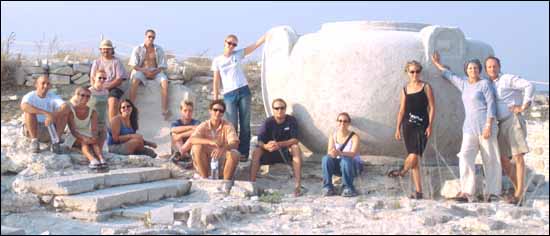
By Tim Kelly Department of Classics Professor Stuart Swiny and 15 of his students excavated an important archaeological site in Southern Cyprus for six weeks this past summer.
�The purpose was to verify the degree to which the Bronze Age site at Pyrgos was involved in copper manufacturing, because articles had been published saying that it had been a major copper producing center,� said Swiny.
Copper was a very important strategic material during the Bronze Age because it was a crucial element in the manufacturing of weapons. Cypriot archaeologists still do not know how copper was smelted prior to Classical times, about 400 B.C., and any site where smelting occurred before that would be an important archaeological discovery.
Maria Rosaria Belgiorno, a researcher for the National Italian Research Institute, reported evidence of copper smelting at a site near the village of Pyrgos. Smelting was reported to have occurred there as far back as 2000 B.C., making it the oldest copper-smelting site ever discovered on the island.
Swiny and the students, under the official title of the University at Albany Archaeological Expedition to Pyrgos, uncovered evidence that disproved Belgiorno�s claim that copper smelting had been taking place in the areas she has excavated. Belgiorno had found features that she suspected were furnaces used for producing the metal. After last summer�s excavation, Swiny asserted that they were definitely not used for smelting copper, but may at best have played a secondary role in the manufacturing of finished copper objects.
�Copper was being smelted in the general area, but this was not happening where we were digging,� said Swiny. They did find quite a lot of copper slag, but he suspected that it had been produced as the result of smelting activities several hundred yards farther up the hill, not directly at the site under excavation.
The students were expected to actively participate in the excavation. Although Belgiorno and her students were there for the first two weeks, the rest of the time it was basically a University at Albany dig. They would start work at 6 a.m. and work through the intense Mediterranean heat until 2 p.m., then they would return to base, an elementary school in the village of Pyrgos. After lunch and a siesta, they would then spend an additional two hours counting and sorting pottery from the day�s dig.
�The Albany students were a great lot,� Swiny said. �They were tough, resilient, hard working, and they never complained. I�ve never had a better group.� The students faced obstacles that included temperatures over 100 degrees, dust, and insects.
The students, many of whom were participating in their first archaeological dig, were expected to work hard.
Bill Weir, a UAlbany senior and a first-time participant, said, �If you found it, you got to work on it,� regardless of skill level.
Corrine Hahn, who is studying classical archaeology at the graduate level and had been to Cyprus before, said, �It was a lot more difficult than I thought it would be. You really have to understand the different stratagraphic levels. It was definitely harder than I expected.� She had gone to Cyprus in 1997 with Swiny to survey for sites around the village of Sotira, 20 miles west of Pyrgos, but they had not done any digging. Hahn plans to return to Cyprus in January and June to do research for her thesis.
Christine Bicker, another senior, said, �I�ve had Stuart as a teacher before and I went in knowing that I was going to learn a lot. That�s totally what I got.� Bicker had participated in an excavation in Cyprus the previous summer. Although she had dug before, she said that the soil and time periods were different between the excavations. Bicker added that she had �learned what it takes to be out in the field.�
Swiny only brought UAlbany Cypriot archaeology students with him and many of them received University credit for participating in the excavation. He was assisted by his wife, Helena, who curates the Cesnola Collection of Cypriot Antiquities at the Semitic Museum, Harvard University.
�The students worked hard and enjoyed a great experience,� Swiny said. �What better education can you get?� He plans to go back to Cyprus next summer to resume work on the Early Bronze Age site he discovered near the village of Sotira.
The students also received an education in culture. Weir said, �They (the Cypriots) are incredibly nice, gracious people. You don�t have to worry about anything.� He added that �Cyprus was great� and that he plans to go back with Swiny next year.