HISTORY OF THE OZONE LAYER
| 600,000,000 B.C. | Ozone layer forms |
| late 1830's | Christian Schöenbein identifies ozone in the laboratory |
| 1845 | Auguste de la Rive and Jean-Charles de Marignac suggest ozone is a form of oxygen; confirmed by Thomas Andrews in 1856 |
| 1858 | Andrei Houzeau finds ozone present in natural air |
| 1865 | Jean-Louis Soret proves that ozone is O3 |
| 1879 | Marie Alfred Cornu measures solar spectrum and finds sharp cutoff in ultraviolet (UV) light |
| 1881 | Walter Hartley recognizes cutoff corresponds to UV absorption by ozone |
| 1913 | John William Strutt (Lord Rayleigh) shows absorption is not in lower atmosphere |
| 1919 | Charles Fabry makes first spectrometric measurements of "thickness" of ozone layer |
| 1924 | G.M.B. Dobson develops ozone spectrophotometer and begins regular measurements of ozone abundance (Arosa, Switzerland) |
| 1925 | Jean Cabannes and Jean Dufay show ozone is about 10 miles high |
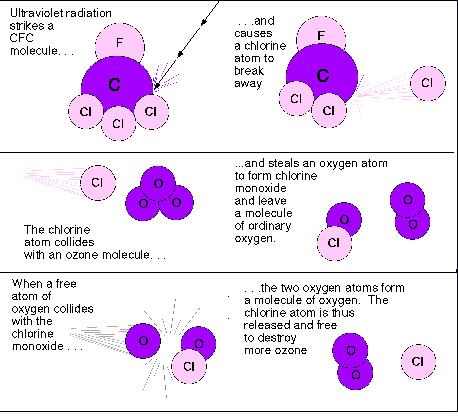
| 1928 | Thomas Midgley synthesizes chlorofluorocarbons (CFC's) |
| 1929 | Umkehr method for Dobson instrument establishes that ozone maximum is below 15 miles altitude |
| 1930 | Sydney Chapman describes theory that explains existence of an ozone "layer" |
| 1934 | Ozonesonde (balloon) measurements establish the ozone concentration is maximum around 12 miles up |
| 1930's | GM develops applications for CFC's |
| 1950 | David Bates and Marcel Nicolet propose catalytic (HOx) ozone destruction |
| 1957 | Global network of Dobson spectrophotometers established during the International Geophysical Year (IGY) |
| late 1950's | CFC market expands rapidly |
| early 1960's | Catalytic destruction is necessary in order to explain ozone amounts |
| 1960's | Boeing proposes supersonic transport (SST) fleet of 800 aircraft |
| 1969 | Paul Crutzen discovers NOx catalytic cycle |
| 1971-74 | Dept of Transportation sponsors intensive program of research, The Climatic Impact Assessment Program (CIAP) |
| 1971 | Congress axes funding for the SST
|
| 1971 | Johnston calculates that NOx from SST's could deplete ozone layer |
| 1973 | Rick Stolarski and Ralph Cicerone suggest catalytic capability of Cl |
| 1973 | James Lovelock detects CFC's in atmosphere |
| 1974 | Sherwood Rowland and Mario Molina warn of ozone depletion due to CFC's |
| March 1977 | First international meeting (Washington DC) to address issue of ozone depletion held by the United Nations Environmental Programme (UNEP) |
| March 1978 | US bans non-essential use of CFC's as aerosol propellant |
| 1978 | Total Ozone Mapping Spectrometer (TOMS) is launched aboard NIMBUS-7 spacecraft giving global coverage of ozone layer thickness |
| 1980's | Renewed expansion of CFC market |
| Oct 1982 | Shigeru Chubachi measures low ozone over Syowa, Antarctica (reported at Ozone Commission meeting in Halkidiki, Greece in Sept 1984) |
| 1984 | British Antarctic Survey scientists discover recurring springtime Antarctic ozone hole (published in Nature May 1985) |
| March 1985 | Vienna Convention for the Protection of the Ozone Layer
|
| Sept. 1987 | Montreal Protocol on Substances That Deplete the Ozone Layer (Amendments - London 1990; Copenhagen 1992) |
| March 1988 | DuPont agrees to CFC production phase-out |
| late 1980's | Ten years of satellite data begin to show measurable ozone depletion globally |
| 1991 | DuPont announces phase-out of CFC production by end of 1996 |
| 1992/3 | Abnormally low ozone observed globally |
| 1995 | Crutzen, Rowland, and Molina win Nobel Prize in Chemistry |
| mid-1990's | springtime Arctic ozone dent appearing |
| Jan. 1996 | CFC production ends in US and Europe |
| 2000 | Maximum CFC concentrations in stratosphere are reached |
| 2010 | CFC production ends world-wide |
| Today | The Ozone Layer - Global Map |
| | THE FUTURE |
| 2030 | Hydrochlorofluorocarbon (HCFC) alternatives are phased out |
| 2040 | HCFC production ends world-wide |
| 2050 | Springtime Antarctic ozone hole disappears |